

Published for North Alabama home sellers | Updated 2026 | Serving Huntsville, Madison, Athens, Limestone County, Ardmore & Decatur
The Quick Answer (TL;DR)
A seller net sheet — sometimes called a seller’s estimated proceeds statement — is a line-item breakdown of every dollar coming in and going out of your home sale transaction. It takes your contract price and subtracts agent commissions, closing costs, title fees, prorated taxes, any buyer concessions, and your remaining mortgage payoff to give you one number: what you’ll actually walk away with at closing. If you’re selling a home in Huntsville, Madison, Athens, or anywhere in North Alabama and you haven’t seen a seller net sheet calculator Alabama estimate before accepting an offer, you’re making one of the most important financial decisions of your life without knowing your real bottom line.
This guide explains every line item on a typical Alabama seller’s net sheet, what’s negotiable, what isn’t, and how to use it to evaluate offers with confidence rather than guesswork.
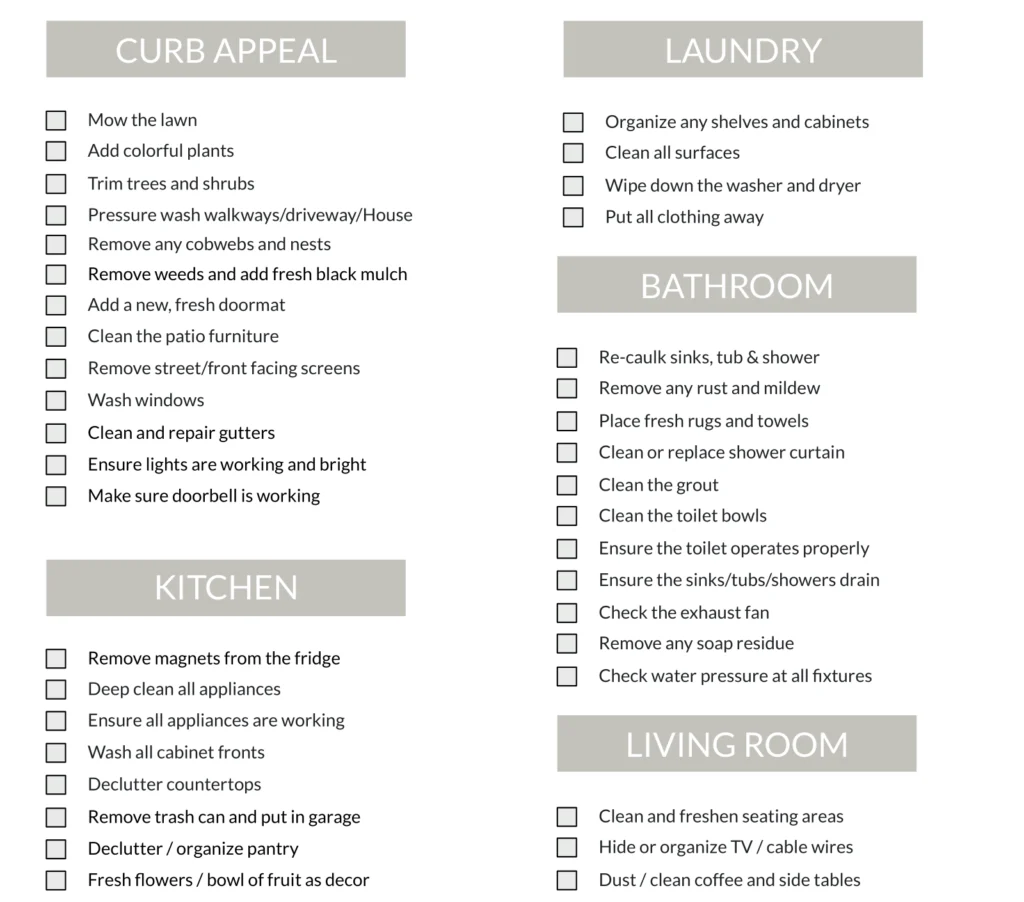
→ New to the selling process? Start here first: Huntsville Home Selling Timeline: How Long Does It Really Take?Work through the high-ROI items first. If time or budget runs out, you’ve already done the things that matter most.
Why the Net Sheet Matters More in North Alabama Right Now
Understanding your net proceeds isn’t just a formality, it’s a strategic tool. In a market where concession requests, rate buydowns, and negotiated closing cost contributions have become more common across all North Alabama submarkets, sellers who don’t have an accurate net sheet before they go under contract are regularly surprised at the closing table.
Here’s how net sheet dynamics play out differently across the region:
Huntsville
In Huntsville’s mid-to-upper price ranges, buyer requests for seller-paid closing costs and rate buydowns have increased as mortgage rates have remained elevated. A seller who doesn’t account for a potential $5,000–$10,000 concession request in their net sheet may accept an offer believing it’s stronger than it actually is once concessions are netted out.
Madison & Madison City Schools
Madison homes tend to command stronger prices, but they also carry higher property tax prorations — particularly for newer construction in communities like Merrill Park and Stone Bridge Farms. Property tax prorations at closing can run several thousand dollars depending on the time of year you close. Sellers who budget only for commissions and title fees consistently underestimate their total deductions.
Athens & Limestone County
In Athens and Limestone County, where buyer budgets are tighter and concession requests are common, the gap between contract price and actual net proceeds can be particularly wide. A $280,000 offer with $7,000 in seller-paid concessions produces a very different net sheet than a $280,000 offer with none, understanding that difference before you sign is essential.
Ardmore & Decatur
In Ardmore and Decatur, where price sensitivity is highest and negotiation is more deliberate, net sheet literacy is especially valuable. Sellers who can clearly explain why they need a specific net minimum are better equipped to hold their position during negotiations than those working from a vague sense of what the sale should produce.

How to Read a Seller Net Sheet: Every Line Item Explained
A typical Alabama seller’s net sheet works from top to bottom — starting with your gross sale price and subtracting each category of costs until you arrive at your estimated net proceeds. Here’s what each section means and what to expect in the North Alabama market.
Line 1: Contract Sales Price
This is the agreed-upon purchase price in the contract — your gross number before any deductions. Everything else on the net sheet is subtracted from this figure. Note that this is the contract price, not the appraised value. If the home appraises below contract price and you’ve agreed to reduce the price, that reduction flows through here.
Lines 2–3: Real Estate Agent Commissions
Commission is typically the largest single deduction on the net sheet. In Alabama, total commission is negotiable and is typically split between the listing agent and the buyer’s agent. Commission is calculated as a percentage of the contract sales price. Your net sheet should show the commission structure clearly and separately from all other fees so you can evaluate it as a standalone line item. For context on how concessions and commission interact: Should You Offer Buyer Concessions in 2026? When It Helps (and When It Hurts)
Lines 4–6: Seller Closing Costs
Alabama sellers typically pay 1–2% of the sales price in closing costs beyond commission. These include:
- Alabama deed transfer tax — currently $0.50 per $500 of value (or fraction thereof)
- Title insurance — sellers in Alabama often pay for the owner’s title insurance policy, which typically runs 0.3–0.5% of the sales price
- Settlement / closing attorney fee — Alabama is an attorney-closing state; closing attorney fees for sellers typically run $300–$600
- Recording fees — nominal, typically $50–$100, covering the cost of recording the deed transfer with the county
- Document preparation fees — charged by the title company or closing attorney, typically $100–$250
Lines 7–8: Prorations
Prorations are credits or debits that account for expenses that have been paid (or not yet paid) for the period of time you owned the home during the current tax or billing cycle. In North Alabama, the two most common prorations are:
- Property tax proration — Alabama property taxes are paid in arrears. You’ll owe a credit to the buyer for the portion of the current tax year during which you owned the home. On a $350,000 Madison home with a $3,200 annual tax bill, closing in July means crediting the buyer roughly $1,600.
- HOA dues proration — if your home is in an HOA, dues paid in advance will produce a credit back to you; dues unpaid will produce a debit against your proceeds.
Lines 9–10: Mortgage Payoff Amount
Your mortgage payoff is the amount required to fully satisfy your loan on the day of closing — not your current statement balance. Payoff amounts include accrued interest through the payoff date and any applicable prepayment penalties (rare but worth confirming with your lender). Request a formal payoff quote from your lender as soon as you go under contract so your net sheet reflects the accurate number. Payoff quotes are typically valid for 30 days.
If you have a second mortgage, HELOC, or any other lien on the property, each one requires a separate payoff that appears as an additional deduction on the net sheet.
Lines 11–12: Seller-Paid Concessions
Concessions are amounts the seller agrees to pay on behalf of the buyer — typically toward the buyer’s closing costs or as a rate buydown contribution. They’re negotiated in the purchase contract and appear as a direct deduction from your net proceeds. A $5,000 concession on a $300,000 sale effectively reduces your net by $5,000 — the same as if the buyer had negotiated the price down by that amount, but with different tax treatment.
Concessions have become more prevalent across North Alabama as buyers manage affordability pressures from elevated mortgage rates. Understanding their net impact before you accept an offer is critical.
Lines 13–14: Repairs, Home Warranty, and Other Agreed Credits
Any repair credits, inspection-negotiated allowances, or seller-provided home warranty premiums appear here. These are often not anticipated in the initial net sheet but get added after inspection negotiations — which is why it’s worth running an updated net sheet after any inspection period renegotiation before you finalize the deal.
Line 15: Estimated Net Proceeds
This is your number. Contract price, minus commissions, minus closing costs, minus prorations, minus payoff, minus concessions and credits. This is what lands in your account or arrives as a check at the closing table.
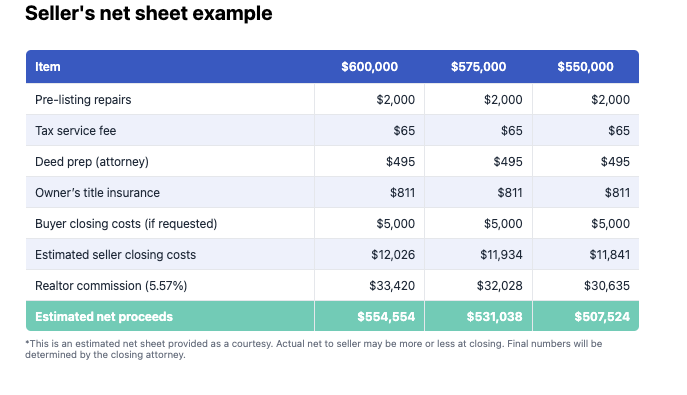
Example Seller Net Sheet: North Alabama Home at $350,000
The following is a simplified example for illustrative purposes. Actual figures vary based on your specific loan balance, tax situation, commission structure, and negotiated terms.
| Line Item | Example Amount | Notes |
| ▸ CONTRACT SALES PRICE | ||
| Contract Price | $350,000 | Your agreed purchase price |
| ▸ COMMISSIONS | ||
| Listing Agent Commission | − $7,000 | Example: 2% of sales price |
| Buyer’s Agent Commission | − $8,750 | Example: 2.5% of sales price |
| ▸ CLOSING COSTS | ||
| Alabama Deed Transfer Tax | − $350 | $0.50 per $500 of value |
| Owner’s Title Insurance | − $1,225 | Approx. 0.35% of sales price |
| Closing Attorney Fee | − $450 | Typical range: $300–$600 |
| Recording & Doc Prep Fees | − $175 | Nominal — varies by county |
| ▸ PRORATIONS | ||
| Property Tax Proration | − $1,400 | Jan–Jul close on $2,400 annual bill |
| HOA Dues Proration | − $250 | If applicable |
| ▸ PAYOFF & LIENS | ||
| Mortgage Payoff Amount | − $198,000 | Contact lender for formal quote |
| ▸ CONCESSIONS & CREDITS | ||
| Seller-Paid Buyer Concessions | − $5,000 | If agreed in contract |
| Post-Inspection Repair Credit | − $1,500 | If negotiated after inspection |
| ▸ ESTIMATED NET PROCEEDS | ||
| Your Estimated Net at Closing | ≈ $125,900 | Before any capital gains considerations |
This example illustrates why a $350,000 offer does not produce $350,000 in your pocket — and why knowing your real number before you list, not after you accept an offer, is the only way to negotiate from a position of strength.
A Note on Capital Gains Tax
Your net proceeds from closing are not necessarily your final tax picture. If you’ve owned and lived in the home as your primary residence for at least two of the last five years, the IRS allows you to exclude up to $250,000 in capital gains ($500,000 for married couples filing jointly) from federal income tax under Section 121 of the Internal Revenue Code. For most North Alabama sellers, this exclusion eliminates any federal capital gains tax liability on the sale entirely.
However, if you’ve owned the property for a shorter period, if it has been used as a rental, or if your gain exceeds the exclusion threshold, capital gains tax may apply. The IRS Topic 701 — Sale of Your Home provides the authoritative federal guidance. Alabama also taxes capital gains as ordinary income at the state level for gains that exceed the federal exclusion. Consult a tax professional before closing if any of these situations apply to your sale.

Your Net Sheet Readiness Checklist
Before you go under contract, make sure you have each of these numbers in hand. Your listing agent should help you compile all of them.
✅ Seller Net Sheet Preparation Checklist
✓ Contract sales price confirmed and in writing
✓ Commission structure documented (listing + buyer’s agent)
✓ Formal mortgage payoff quote requested from your lender
✓ Second mortgage or HELOC payoff obtained (if applicable)
✓ Current annual property tax bill located (for proration calculation)
✓ HOA balance and payment schedule confirmed (if applicable)
✓ Title insurance estimate obtained from closing attorney
✓ Any agreed concessions or credits documented in the contract
✓ Post-inspection repair credits noted and net sheet updated
✓ Capital gains eligibility reviewed with a tax professional (if applicable)
✓ Updated net sheet reviewed before signing closing documents
Common Seller Net Sheet Mistakes (And How to Avoid Them)
Mistake #1: Waiting Until Closing Day to See the Numbers
The net sheet should be your first conversation with your listing agent — not a document you see for the first time at the closing table. Sellers who don’t review a net sheet before accepting an offer frequently discover at closing that their actual proceeds are $8,000–$15,000 lower than they expected. By then, there’s nothing to negotiate. Build your net sheet before you list, update it when you receive offers, and update it again after any inspection renegotiation.
Mistake #2: Confusing List Price with Net Proceeds
The list price is what you’re asking. The net proceeds are what you keep. These numbers are rarely close to each other. On a $350,000 home in North Alabama, total deductions of $50,000–$75,000 are common once commissions, payoff, closing costs, and any concessions are accounted for. Setting a list price without knowing your minimum net is like negotiating without knowing your bottom line — which is exactly the position it puts you in.
Mistake #3: Not Accounting for the Mortgage Payoff Accurately
Many sellers estimate their payoff from their most recent mortgage statement — which reflects their principal balance, not their true payoff amount. The actual payoff includes accrued interest through the payoff date and may differ by hundreds or thousands of dollars from the statement balance. Always request a formal payoff quote from your lender as soon as you have a contract in hand.
Mistake #4: Ignoring the Proration Impact
Property tax prorations are invisible until they appear on the net sheet — and for sellers in Madison with higher assessed values, they can represent a meaningful deduction. A home with a $4,800 annual tax bill closing in October owes the buyer approximately $4,000 in proration credit (ten months of taxes the seller owes but the buyer will pay). Sellers who don’t anticipate this are regularly surprised.
Mistake #5: Evaluating Offers on Price Alone
A $310,000 offer with $8,000 in concessions nets you $302,000 before other deductions. A $305,000 offer with no concessions nets you $305,000 before other deductions. The lower-priced offer produces better proceeds. Running a separate net sheet for each offer you receive — accounting for its specific concession terms, closing date, and any credits — is the only way to compare offers accurately.
Frequently Asked Questions
What is a seller net sheet and when should I get one?
A seller net sheet is a line-item estimate of your home sale proceeds after all deductions — commissions, closing costs, prorations, mortgage payoff, and any agreed concessions. You should get one before you list so you know your minimum acceptable offer, update it when you receive offers, and update it again after any inspection renegotiation. Your listing agent should provide this as a standard part of the pre-listing conversation — not something you have to request.
How much do sellers typically pay in closing costs in Alabama?
Alabama sellers typically pay 1–2% of the sales price in closing costs beyond agent commissions. This includes deed transfer tax, owner’s title insurance, closing attorney fees, recording fees, and document preparation charges. On a $350,000 home, expect $2,000–$4,000 in seller-paid closing costs before commissions and payoff are factored in. Total deductions including commissions and payoff typically run 25–35% of the gross sales price depending on your remaining loan balance.
Can I use an online seller net sheet calculator for Alabama?
Online calculators can give you a rough estimate, but they frequently miss Alabama-specific costs like deed transfer tax rates, regional title insurance premiums, and the nuances of local HOA proration practices. They also can’t account for your specific negotiated concessions, your actual mortgage payoff amount, or your home’s specific tax assessment. Use online tools for ballpark context, but rely on a net sheet prepared by your local listing agent using actual figures for any decision-making.
Do I have to pay capital gains tax when I sell my home in Alabama?
For most homeowners, no — not on the federal level. The IRS Section 121 exclusion allows you to exclude up to $250,000 in capital gains ($500,000 for married couples filing jointly) if you’ve owned and lived in the home as your primary residence for at least two of the last five years. Alabama taxes capital gains as ordinary income for amounts exceeding the federal exclusion. If your situation involves a short ownership period, a rental history, or gains above the exclusion threshold, consult a tax professional before closing.
What happens to my net sheet if the buyer requests concessions after the inspection?
Concessions negotiated after inspection — repair credits, price reductions, or closing cost contributions — directly reduce your net proceeds. Your agent should update your net sheet immediately after any post-inspection negotiation so you can evaluate the revised deal with full visibility. A $3,000 repair credit on a net sheet you were already working with slim margins may be a deal-breaker that a quick net sheet update makes obvious before you agree to it.
How is the seller net sheet different from the Closing Disclosure?
The seller net sheet is an estimate prepared before or during the transaction to help you plan and negotiate. The Closing Disclosure (CD) is the official settlement statement prepared by the closing attorney that reflects the final, legally binding numbers. You should receive the CD at least 24 hours before closing. Review it carefully against your most recent net sheet estimate and flag any discrepancies with your agent before you sit down to sign.

Your Next Step: Get Your Free Seller’s Net Sheet
Selling a home in Huntsville, Madison, Athens, Limestone County, or anywhere in North Alabama without a current, accurate seller’s net sheet is one of the most preventable financial mistakes in real estate. The numbers aren’t complicated — but they need to be your numbers, built on your payoff, your tax situation, your commission structure, and the specific terms of the offers you’re evaluating.
That’s exactly what a free listing consultation with North AL Property Group provides — a fully built net sheet before you commit to anything, so you walk into every negotiation knowing exactly what you need and exactly what you’ll walk away with.
→ See also: Should You Offer Buyer Concessions in 2026? When It Helps (and When It Hurts)
→ See also: Relocating to Huntsville? A Seller’s Playbook for Timing Your Move
Get Your Personalized Seller’s Net Sheet — Free
Know exactly what you’ll walk away with before you list. No pressure, no obligation.→ Book Your Free Listing Consultation with Jason Roberts at NorthALPropertyGroup.com
More Resources for North Alabama Home Sellers
→ Huntsville Home Selling Timeline: How Long Does It Really Take?
→ How to Price Your North Alabama Home Without Leaving Money on the Table
→ Pre-Listing Checklist: 21 Things That Increase Your Sale Price (ROI First)
→ IRS Topic 701 — Sale of Your Home (Capital Gains Guidance)
| Ready to Sell for More? Let’s Build Your Pre-Listing Plan. Get a free listing consultation, a seller’s net sheet, and a customized prep plan for your North Alabama home.→ Book Your Free Consultation with Jason Roberts at North AL Property Group |